

The History of the Pazo
We owe the vast majority of the information on the history of the pazo to the efforts and kindness of the historian and author Mr Xosé Ricardo Rodríguez Pérez:
It is a place in Maceda, situated below the castle to the south: a stretch of land or valley, the name of which derives from Chaos de Maceda, Chaira, Chaíza, Chaínza, Sainza, etc. A ‘chairo’ or ‘chaioso’ place, that is to say, flat. The Counts of Maceda were related to many families: Sotelo, Feijoo, Gaioso, etc., and likewise to the Counts of Monterrey, as well as to the lords of Chaioso, a house situated below their castle, as their surname, Nóvoa, suggests. I would add that this lineage originated in the place of the same name: Nóboa or Nóvoa, parish of San Esteban, judicial district of Ribadavia. This lineage, now united with the Yáñez family, settled in the Alta Limia under Pedro Yañez de Novoa y Parada, and others in the Americas. He details this, starting from the Latin and tracing the etymological line back to Chaioso. Pages 463 and 464 of the aforementioned work *A LIMIA; VAL DA ANTELA E VAL DO MEDO*.
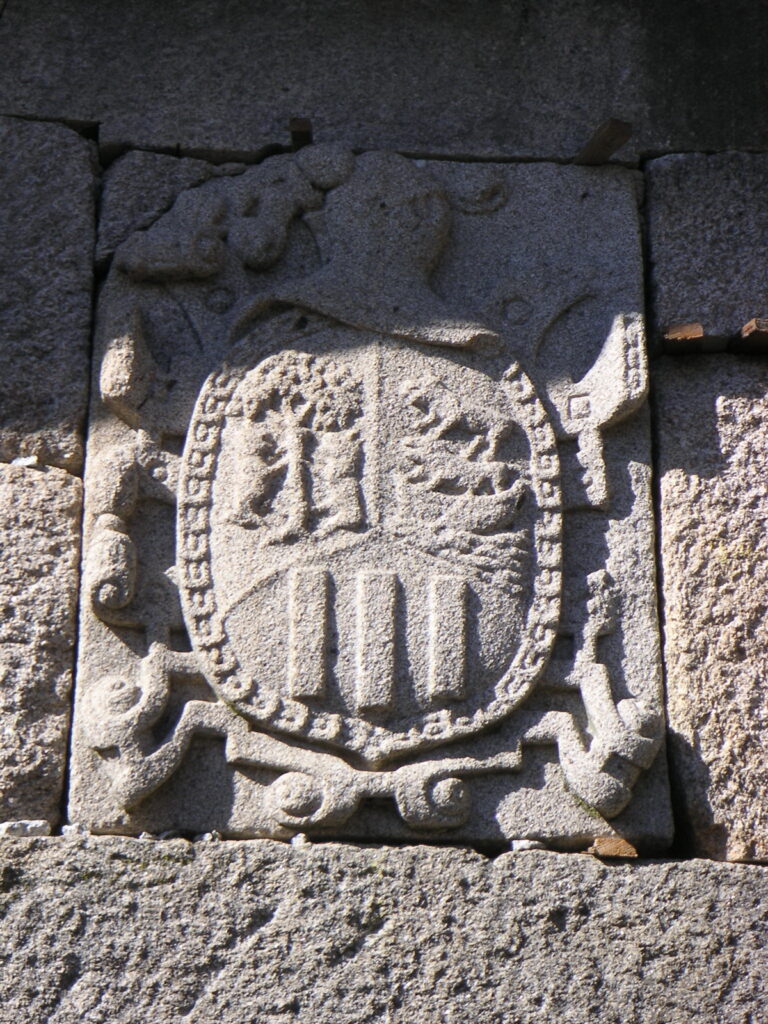
The coat of arms of the Alpendre (17th century)
We know that the coat of arms on the façade of the Alpendre dates from the second half of the 17th century, a fact confirmed by Professor Florencio Rodríguez-Montero.
According to his explanation, the coat of arms shows, in the top left corner, two goats erected against an oak tree, the arms of the Sotelo family. In the top right corner are two wolves inside a boat on the water, the arms of the Cadórnigas family, a family directly related to the Castle of Maceda. Finally, at the bottom are the three bands of the Rivera family.
The coat of arms above the entrance to the courtyard
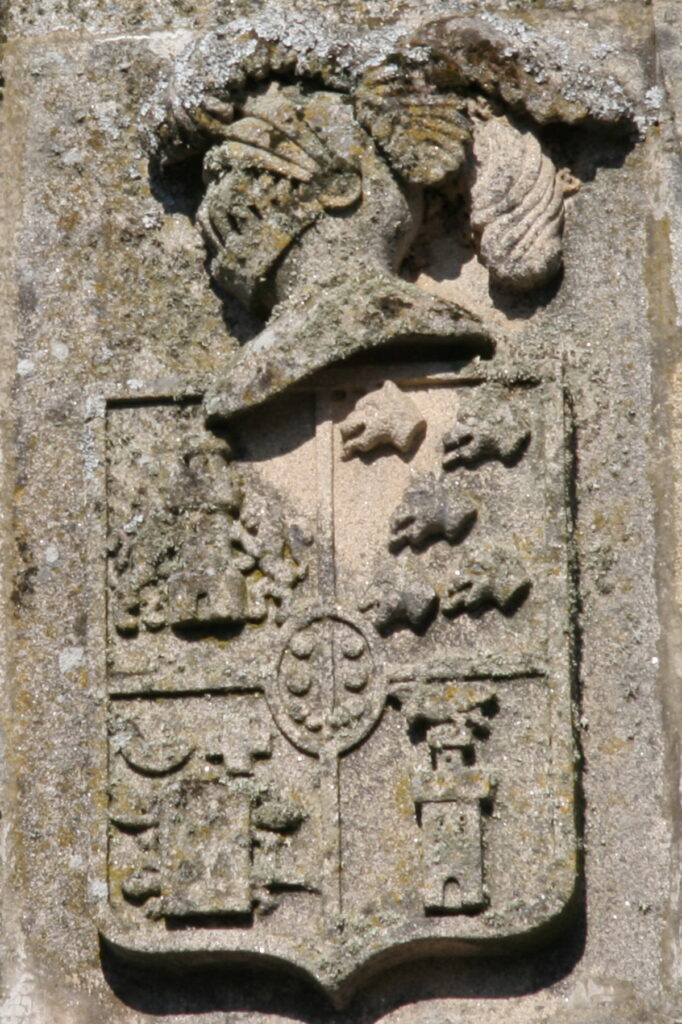
The coat of arms on the entrance gate to the courtyard, apparently almost two centuries younger than the one mentioned above, features the Feijoo coat of arms in the centre, the Novoa coat of arms top left, the five bleeding wolf heads of the Mosquera family top right, the lizards beneath a slab of the Losada family bottom left, and finally the Salgado coat of arms bottom right. We are grateful for this information to the historian Mr Xosé Ricardo Rodríguez Pérez; here is a link to the list of his publications.
The chapel (first mentions and permits)
The chapel belonging to the Pazo appears to be first mentioned in 1735: “Maceda, Lugar de Chaioso 1735”. Requested by Don Miguel de Losada, lawyer at the Royal Court of Galicia, and his wife Doña Luisa Feijoo y Sotomayor. For their homes in the village of Chaioso, parish of San Pedro de Maceda. Granted by Pope Clement XII on 1 October 1735. On 21 June 1736, it was recognised by the parish priest of Santa Mariña de Asadur. ‘There, set apart from the hustle and bustle of the people, is a very clean and tidy oratory with its altarpiece and the image of the Most Holy Christ, and the necessary decorations, both of which are very decent and neat, so that the Holy Sacrifice of the Mass may be celebrated there…’ (AH OURENSE 450/14).
Having been widowed, Doña Luisa remarried Don Francisco Saavedra y Mosera, mayor of the district of Maceda; and, having set aside a better room for the oratory by extending the house in Chaioso, they both… Following Doña Luisa’s death, her children received a new charter for the oratory from Pope Clement XIII on 23 June 1764, authorising the Bishop of Ourense to celebrate Mass there (AHDOURENSE. 6104/13).
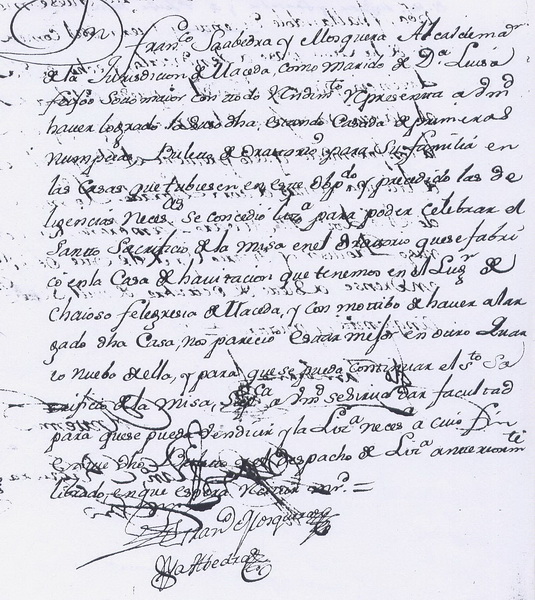
Document from 1768 regarding the renewal of the permit
Regarding the chapel, we have found, also thanks to the tireless efforts of Mr Xosé Ricardo Rodríguez Pérez, a document dating from 1768:
“CHAIOSO, application for renewal of the licence for Masses in the chapel of this manor house by Don Francisco Saavedra y Mosquera, Mayor of the Jurisdiction of Maceda, as husband of Doña Luisa Feijoo Sotomayor, with full consent (granted to), reports to Your Grace that the aforementioned, being married in her first marriage, Oratory Permit for her family in the houses they owned in this Diocese, having obtained the necessary licences beforehand. A Licence was granted to celebrate the Holy Sacrifice of the Mass in the Oratory built in the dwelling we own in the village of Chaioso, Parish of Maceda, and as we have extended said house, it seemed best to us to move to another new room therein, and so that the Holy Sacrifice of the Mass may continue, we humbly request that Your Grace grant permission for it to be consecrated and issue the necessary licence, for which purpose we enclose the aforementioned Buleto and the licence previously issued, which we hope to receive).”
Signatories to the application
The application is signed by Don Jacobo, Don Joseph, Don Bernardo, Don Francisco, Don Thomas, Don Teodoro, Don Phelipe, Don Clemente and Doña Juana Mosquera Feijoó Sotomaior, siblings and residents of Chaioso, in San Pedro de Maceda, and Don Francisco Saavedra y Mosquera.
The Pazo and its legends
Another interesting fact is that the Count of Maceda, Alonso de Lanzós Andrade y Novoa, son of Aldonza de Nova, Lady of Maceda, born in 1540, who lived in the castle situated some 400 metres above, had the manor house built for an illegitimate son, which would add some 100 years to the manor house’s history. And let’s not forget the legend that there is a tunnel between the manor house and the castle, inhabited by a giant snake – something we have not yet been able to verify.Last residents before the renovation
The last people to live in the Pazo before we began renovating the building were Mr Ramón Villarino de Saá and his wife, Mrs Araceli Anta Novoa. According to Wikipedia and our research, Ramón Villarino de Saá was editor-in-chief of El Eco Antelano (1911–1912). After completing his law degree in Madrid, he gave lectures at the Ateneo de Madrid. He then returned to Ourense, where he worked as a state lawyer and edited the then-newspaper ‘El Diario de Orense’, apparently also contributing to ‘La Centuria’ and ‘La Región’, amongst others. During the Republic, he was a member of the Provincial Committee of Popular Action in Ourense and, in the 1936 general election, was elected as a Member of Parliament for Ourense for the CEDA. After the Civil War, in which – unlike others – he interceded on behalf of some local residents, he served as a lawyer for the Bishopric in Ourense, where he died in 1959.